


Glossary of Hypatia Bookbinding Terms: A Guide for Curious Souls – Part I
Updated: Jul 17
If you've ever browsed the Hypatia studio collection and found yourself wondering what Coptic binding means or what khadi paper is, this guide is for you. Whether you're new to artisan bookbinding or a longtime collector of handmade journals, here's a glossary of some terms I use often in describing the Hypatia Collections.
Let’s Talk Paper...
What is Hahnemühle Bugra Paper?
A premium mould-made paper from Germany, Bugra is known for its soft texture, elegant tooth, and beautiful color range. Made from 100% alpha cellulose, it is acid-free and lightly sized, making it ideal for writing, sketching, collage, and mixed media. A perfect and elegant compliment for the Hypatia case binding books, Bugra offers a beautiful balance of strength and softness, and it’s a dream to write upon!
Hypatia books bound with Hahnemühle Bugra Paper: Case Bindings
What is Stonehenge paper?
Stonehenge paper is a traditional fine art paper made to rival the more expensive European mouldmade papers that have gained worldwide recognition as one of the finest papers for pastel, pencil, charcoal, acrylics, watercolor, pen and ink, and even markers.
It combines hefty weight of 250 gsm, 2 deckled edges, with a smooth flawless surface that is slightly mottled to resemble vellum. Acid-free and 100% cotton.
Hypatia books bound with Stonehenge paper: Button Hole Stitch Bindings
What’s Khadi Cotton Rag Paper?
Archival quality, environmentally friendly Khadi cotton rag paper is made from 100% cotton rag fibers, and has an exquisite texture and tactile feel.
Each sheet bears the unmistakable imprint of the handmade process, with subtle variations in thickness adding to its charm, along with its unique and hand torn deckled edges.
The paper has a soft fibrous surface that’s perfect for a wide variety of artistic and writing mediums, including drawing, painting, mixed media, even fountain pen.
Khadi cotton is beloved by artists and enthusiasts of every level for its exceptional quality, versatility, and immense beauty.
Dyed cotton rag paper is quite rare, but every so often, I come across beautiful finds—soft greys, blush pinks, and delicate mint tones. I've bound these special papers into 4" x 6" leather-bound Avalon journals and used it in the cloth-covered, case-bound Sweet Petits.
Hypatia books bound with khadi cotton rag: Avalon, Coptic, Hypatia's Rose, Sweet Petits
What paper do you use to bind your traditional leather-bound sketchbooks and journals?
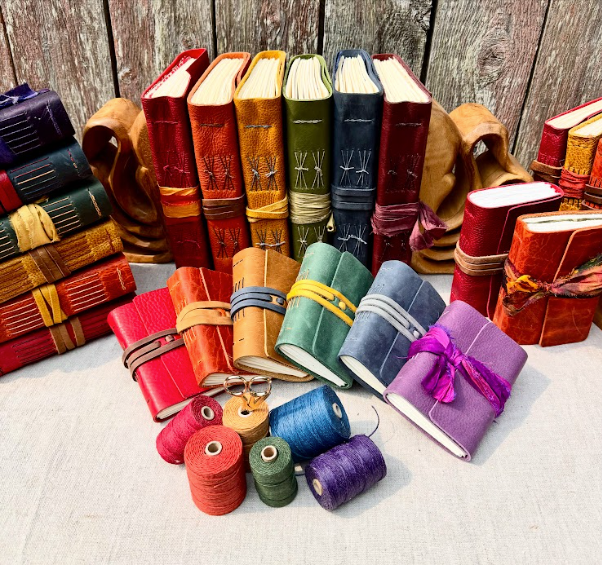
The MERLIN is a traditional leather-bound Hypatia journal/sketchbook, available in five different sizes. Each MERLIN is bound with hand-torn beautifully crafted, lightly textured 160 gsm paper made in Italy. Though not a traditional watercolor paper, its thickness and subtle tooth make it very suitable for light watercolor washes, ink work, collage, and mixed media journaling. The surface is smooth enough for writing while offering just enough grip for dry brush technique or gentle wet media. Great with fountain pen as well.
You often mention “GSM” when describing paper – what does GSM mean?
GSM stands for "grams per square meter," a measurement of paper weight and thickness. The higher the gsm, the heavier and more substantial the paper. For example, the 160 GSM paper in the Merlin books offers a perfect balance of strength and softness—ideal for writing, sketching, and light mixed media—while the lighter handmade papers used in Case Bindings typically range from 80–100 GSM and are beautifully suited for writing, layering, and collage.
Why is a Hypatia book made with Khadi Cotton Rag paper more expensive than a similar size book filled with ‘watercolor’ paper?
Books made with Khadi cotton rag paper are more expensive because of how this paper is made and where it comes from. Khadi paper is handmade sheet-by-sheet in India using traditional methods from 100% recycled cotton rags (not wood pulp), often from the garment industry. Each sheet is individually hand-pulled, sun-dried, and finished with great care ~ giving it a unique texture, soft deckled edges, and a beautiful, natural surface that artists and journalers love.
This artisanal process, combined with international shipping and fair wages for the skilled makers, means the paper itself costs significantly more than even high-quality machine-made watercolor paper.
What exactly is Lokta Paper?
Beautiful handmade lokta paper from Nepal is one of the primary papers used in Hypatia Storytellers. Lokta is produced using bark from the daphne shrub, a cousin to the laurel and the rhododendron.
Lokta is very eco-friendly, as the plant regenerates quickly and is one of the few under-utilized plant resources in the world. Each lokta sheet is made by hand and celebrates its “wabi sabi” beauty.
Delightful to write, paint and glue on, it is incredibly strong and flexible.
What are Cavallini papers ~ Italian Vintage Prints?
Cavallini papers feature exquisite reproductions of vintage artwork sourced from archives around the world, evoking a deep sense of nostalgia, charm, and timeless beauty.
Printed on high-quality, archival Italian paper stock, these pieces are not only beautiful but built to last—perfect for artistic, decorative, and bookmaking applications. Many are so striking they’re framed as art in their own right and collected by lovers of vintage design.
In the Hypatia studio, I delight in carefully folding and hand-tearing these papers into signature pages—so their beauty becomes part of your writing, remembering, and storytelling. Each one adds a touch of history, elegance, and visual delight to your Storyteller.
What are Florentine and Tassotti papers?
With their roots in Renaissance Italy, Florentine papers are known for their intricate patterns, rich colors, and timeless beauty. Traditionally hand-printed using engraved plates or silkscreen techniques, these papers often feature scrolling acanthus leaves, gold flourishes, and classical motifs.
Each sheet is a small work of art—elegant, ornamental, and full of history. Whether used as endpapers or the heart of a journal’s design, Florentine papers bring a sense of old-world refinement and enduring charm to every Storyteller they grace.
Grafiche Tassotti is the present heir to the lineage of hundreds-of-years old master printmaking work of the Remondini family from Bassano del Grappa in northern Italy.They successfully continue their mission to become a creative print workshop where expert hands create refined and exclusive products, preserving an ancient artisan tradition, while attentively safeguarding the planet, using only environmentally friendly inks.
Their prints are exquisite and timeless, and I have the grand fortune of being able to purchase these papers directly from Italy.
What is Japanese Chiyogami and Katazome-shi paper?
This exceptional Japanese paper is made in a precise and laborious process of stenciling and resist dying based on traditional kimono-printing techniques using persimmon-dyed kozo as the stencils and a highly skillful process that produces striking beauty in long-lasting color and the unmistakable look of a print truly made by an adept hand.
The color, quality, beauty, (and cost!) of these exquisite papers always take my breath away! Not only are they visually remarkable, every bookbinder loves working with this Japanese paper because it behaves so well during the intense bookbinding process of cutting, glueing, bone-folding and pressing, where the fibers of ‘lesser’ papers might stretch, distort images, or tear.
What is a Deckled Edge?
A deckled edge is the characteristic soft, irregular border that forms naturally during traditional hand papermaking – or is carefully recreated in the production of high-quality papers today. It occurs when the paper fibers at the sheet’s edge are not sharply cut but flow outwards in a natural, organic way.
Deckled edges are not just a visual detail! They are a mark of true craftsmanship and lend each sheet a sense of uniqueness and character. No edges are ever exactly the same, making every sheet remarkably one-of-a-kind.
Each Hypatia book begins with paper ~ chosen not just for how it looks, but for how it feels, responds, and endures. From the ancient mountains of Nepal to traditional presses in Italy and hand-pulled sheets in India, every page tells its own quiet story before you ever write upon it. I hope this first chapter of our glossary brings you closer to the heart of these handmade treasures—and the deep reverence I have for the materials that shape them.
Stay tuned for Part II, where we’ll explore the bindings, stitches, and structures that bring your Hypatia books to life!


Comments